
A crowd doesn’t always represent wisdom
aka eat at empty places

My pops used to teach lessons in the smallest, slickest ways. One of his earliest: the restaurant test.
You can judge a restaurant by the number of people inside it, he’d say.
We’d walk down a block in Queens and he’d point at a dead, quiet spot with empty tables and a lonely host wiping menus.
Papi, he’d say, empty means questionable.
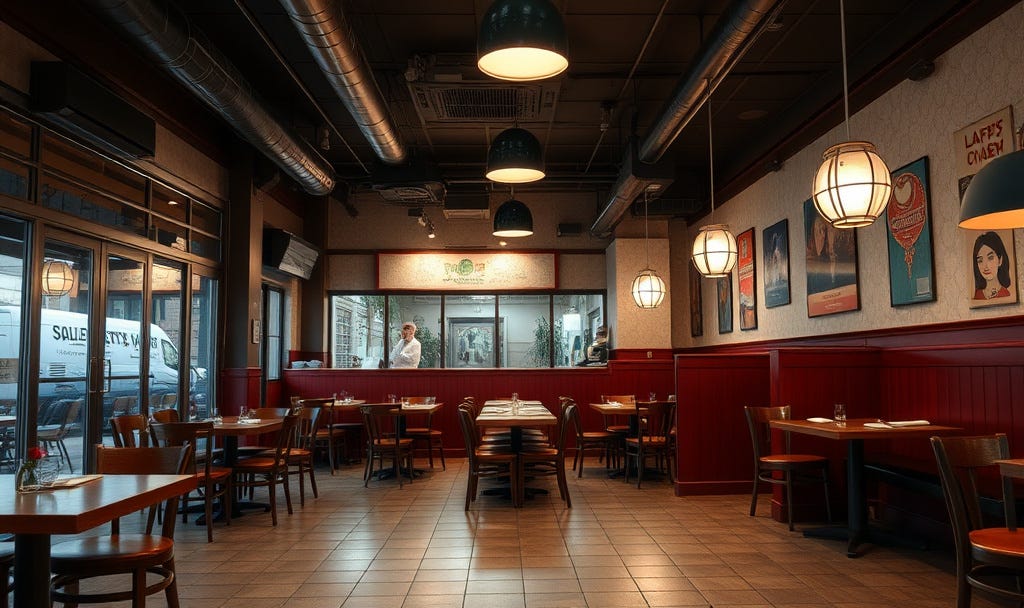
And then two doors down, a place buzzing, people pressed against the front window waiting for a seat, Now this place, jumping. Full means yummy.
At the time, it made sense. It was an immigrant’s logic - trust the collective, trust the crowd, trust the wisdom of people eating with joy. People meant flavor. A crowd meant quality. Heat followed heat. That’s how the world worked, at least according to pops.
But later in life I learned the world is far trickier than that.
Because I’ve been to plenty of places that were jumping and absolutely not yummy. Places where the food was bland but the vibe was loud, where the line outside was longer than the list of ingredients, where the whole point wasn’t taste but the idea of being seen having taste.
People weren’t there for nourishment. They were there for validation.
A crowd doesn’t always represent wisdom. Sometimes a crowd represents momentum. Hype. The gravitational pull of being seen somewhere cool. Many restaurants today are full not because the food is good, but because the place has acquired vibe capital. It’s less follow the flavor and more herd of cattle chasing cool.
Some spot gets mentioned once on a podcast, a trendy blog calls it a must, or a celebrity posts a grainy selfie there, or some TikToker makes a 12-second video talking about hidden gems, and suddenly the whole block becomes a pilgrimage site for influencers and their ring lights.
And the wildest part?
Sometimes the empty place, the one pops told me to question, was the real gem all along. A sanctuary. A secret. A quiet little refuge where regulars knew the chef’s name and the chef knows theirs.
Until someone with a million followers “discovered” it (ala Christopher Columbus) and in an instant, the refuge becomes a photo backdrop. The tables become props. The regulars get pushed to the margins like familiar ghosts. The intimacy evaporates.
What was perfect becomes unrecognizable.
I think pops was right, but only partly. Full places tell you something, but they don’t tell you everything. Crowds can and can’t signal quality. Crowds can also signal hype.
Sometimes emptiness means the food is bad. But sometimes emptiness means the place is sacred. And sacred things don’t survive virality. They can’t. What is holy depends on being held and tended too carefully. Virality is the opposite, designed to spread, flatten, consume, easily digestible and easy in, easy out. It’s antithetical to the sacreds very nature.
Some things were never meant to be discovered by everyone.
If you find medicine here, buy me a coffee and/or support me for just $3.75!
& buy a copy of Brown Enough (one for you, one for the homie, one for the neighborhood library) and listen to Season 3 of the podcast!