
Stop Whitifying Bodegas

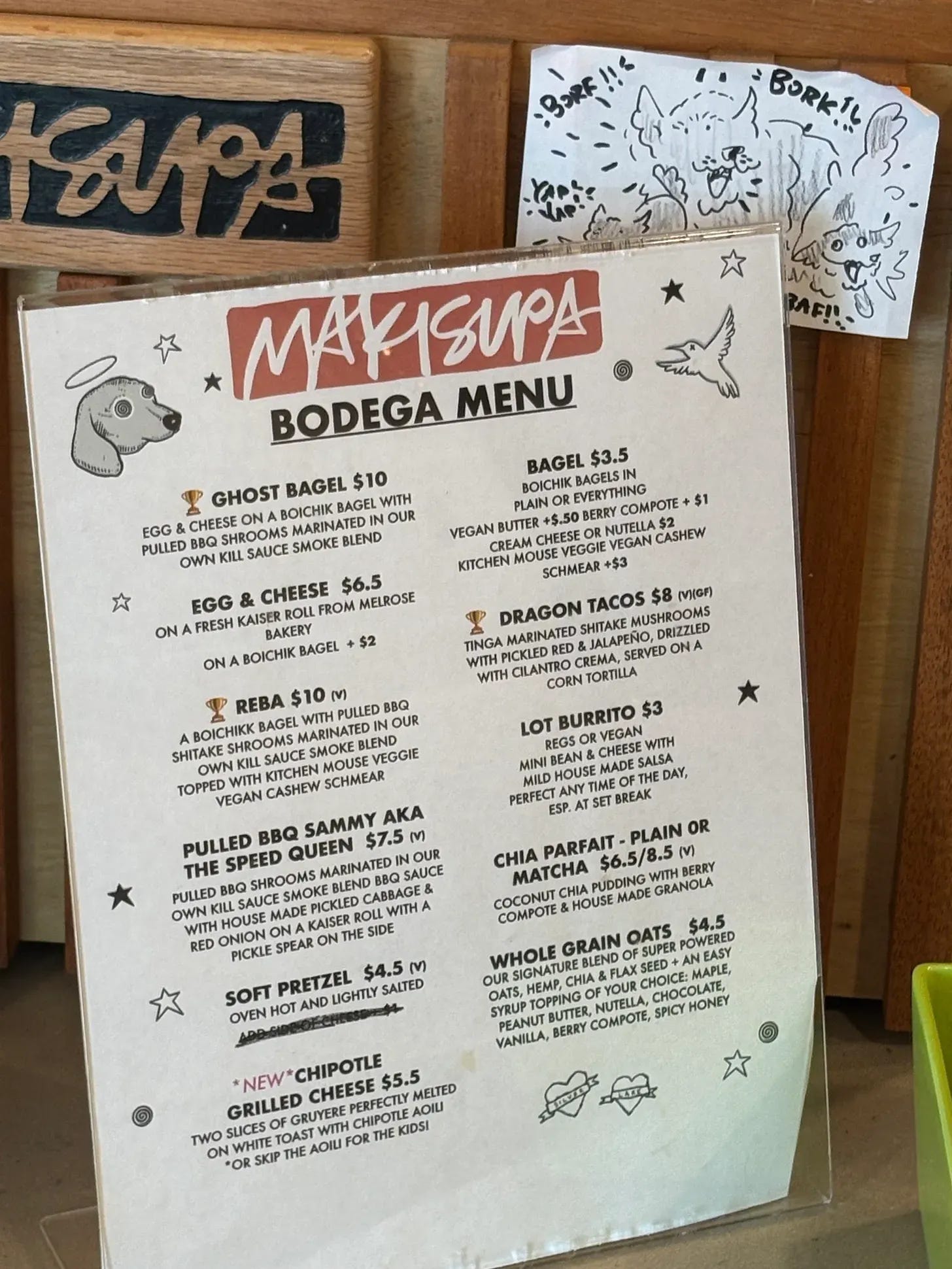
I was standing in a coffee shop in Silverlake looking at a laminated “bodega menu” except it is not a bodega. It’s the furthest thing from it. Bodies of culture have been running bodegas in this country for sixty years, extending credit on trust, keeping lights on in neighborhoods no chain would to uch, way before a barista in a canvas apron could ever be seen there charing 7:50 for an oat milk chai latte.
The American bodega was built by hand, mostly by Puerto Rican migrants after World War II and then by Dominican immigrants from the 1960s on, concentrated in New York and spreading out from there. It was never just a store. It was retail infrastructure for neighborhoods big chains wouldn’t touch or serve. Sometimes it was the only grocery within walking distance in what would otherwise be a food desert. The bodega was also an informal bank, credit on a nod, no application, no interest, no paper trail, just an owner deciding you’re good for it. The owners knew who were sick, who needed work, who hadn’t been seen in a few days, whose kid needed watching after school. A place where parents and their children split sixteen-hour days, living upstairs or three blocks over. The store was family. And of course, all species are welcome - the bodega cat is not a mascot, she’s an employee. She keeps mice out and everyone on the block knows her name.
In 2017, two ex-Google engineers launched an app-controlled vending machine startup and named it Bodega. They wanted the corner store, minus the corner store’s actual owner. This Silverlake coffee shop and many like it are the same thing. The aesthetic gets lifted onto a tote bag while the actual economic and cultural realities of the bodega never makes it onto the menu. Not to mention that this hipster coffee shop bodega is very possibly pricing out the people who actually need a bodega.
This doesn’t stop at a corner store. The food cart did this, Elote sold from a cart with a a cooler of mayo was a street vendor’s livelihood. Put the same corn, the same crema, the same tajín on a slate board for fourteen dollars and call it “elevated street food.” Suddenly it’s a concept a magazine will cover. The corn and mayo are the same, just the context around them changed. It’s like what the late and brilliant Virgil Abloh said about how context shapes the way we see objects: If you place a candle in a gallery, it is viewed as art, but if you place the same candle in a garage, it may be dismissed as trash. Environment and framing influence cultural value. Every time, the object stays exactly the same. What changes is who is standing next to it when the world decides to notice.
This is the pattern, and it repeats over and over: a neighborhood, n a block of Boyle Heights, Bushwick or Pilsen holds three generations of community, and then gets rebranded as an “arts district” or an “up-and-coming” pocket of a bigger-whiter-name. The neighborhood isn’t discovered, it’s renamed, and the renaming is treated as the neighborhood’s origin story instead of its erasure.
A white writer publishes a book on consciousness and it becomes a bestseller, a movement, a frontier. The same indigenous insights have been carried for a thousand years through ritual and lineage, and are suddenly trendy because Western science publishes a paper on the living intelligence beneath the skin, while the East says, yes, we have known this for centuries.
Done once, to one thing or one person, is an injustice. Done for centuries, to entire systems and bodies of culture, it earns a fancier word: epistemicide. The sociologist Boaventura de Sousa Santos used it for the killing-off of whole ways of knowledge under colonization. Empires didn’t only take land and labor. They took the authority to know, and reassigned it. A practice does not have to be banned to be erased; it only has to be reclassified.
The moment a thing is rendered into the language of institutions, credentials, and whiteness, it is permitted to be called innovation. But the knowledge is rarely new. The audience, maybe, is.
Acupuncture was not invented by the people who ran a trial on it. Meditation did not become real when the MRI scanner lit up. Breath did not become medicine when a viral white guy used it to stand in the cold. Indigenous herbal medicine did not start helping and guiding people the day Michael Pollan went to Peru. The bodega cat was not invented by whoever put her on a tote bag. The corner store did not become a concept the day someone in Silverlake put millions into it.
This is an invitation to challenge context and narratives. That to find something is sometimes only to arrive in a place where others have been living, cooking, lending, healing, and keeping the lights on for generations, and to have the grace to notice who was already there.
The bodega does not need whiteness to promote it. It needs to be appreciated, respected, and left alone.
ps. I spoke all of this instead of typing it, using WISPR FLOW - it’s pretty tight
Engaged Liberation is a labor of love.
But it is labor. If you love it, support it for less than $5/mo. Thank you!